Looks like AUCA has its own Banksy, its own anonymous street artist whose motivation might be to provoke thought and conversation as a means to cultivating a persona. Maybe it’s Dope, the Bishkek street artist turned graphic designer who is also known as Denis Kapkanets. Kapkanets helped Bishkek’s street art evolve from spray painted tags to stenciled koans and inscrutable images that he and two cohorts spread around Bishkek on early Sunday mornings before the city woke up. This Think light bulb is stenciled onto the landing of one of the university’s staircases. When a student journalist quizzed the department in charge of building maintenance as to why the light bulb had not been painted over, a worker broke through official demeanor and scripted sound bite-speak and admitted an ambivalence about the work and a reluctance to take sides in street art vs. vandalism polemics. Hmm. Sounds like this piece of stencil art made someone think.
Author: Laura Kelly
Today’s Toiletry
Iron Tooth. It’s a dental floss.
Nostros (return home) + algia (longing)
Every language, it seems, now has a special word for homesickness that its speakers claim to be radically untranslatable—the German Heimweh, the French maladie du pays, the Spanish mal de corazon. Czechs have the word litost, which means at once sympathy, grief, remorse, and indefinable longing. The whispering sibilance of the Russian toska, made famous in the literature of exiles, evokes the claustrophobic intimacy of the crammed spaces whence one pines for the intimate. The same stifling, almost asthmatic sensation of deprivation can be found also in the shimmering sounds of the Polish tesknota, which adds a touch of moody artistry to the Russians, who are enamored of the gigantic and the absolute. The Portuguese and the Brazilians have their saudade, a tender sorrow, breezy and erotic—not as melodramatic as its Slavic counterpart yet no less profound and haunting. Romanians claim that dor, sonorous and sharp like a dagger, is unknown to other nations and speaks of a specifically Romanian dolorous ache. Although each term hews to the specific rhythms of its language, all these untranslatable words are, in effect, synonyms, but synonyms that share a desire for untranslatability, a longing for uniqueness.
~ from The Future of Nostalgia by Svetlana Boym
The Geo-Political Neighborhood
As the United States withdraws, the Chinese move in. An astute analysis from late 2013 of Central Asian and Chinese relationships.
“In summary I can conclude that foreign media usually cover issues about Kyrgyzstan in negative side. And it is still unclear why external journalists, especially from USA try to cause cordial dislike by their coverage. But, of course political reason is the most exact and important in this problem.”
~ from a student paper about external media in Kyrgyzstan
I haven’t precisely traced the genesis of my rapture with all things postal but this geekish thrill includes postcards and letter boxes and mailmen and stamps from foreign countries and the billowing little joy of first receiving the letter and then of opening it.
When I was a young girl, my grandmother and I exchanged a steady correspondence. She lived in southern Alabama; I was growing up on the southern coast of Florida. Although I can’t recall the contours of her face with much clarity, in the eye of my mind I can see her looping penmanship, the blue scrawl and tiny ink blobs from her ballpoint pen, the flourish she added to her capital letters. She wrote on sensible stationary, and her letters contained small stories of her paintings, her dog, her latest outrage with politics. Nothing equalled the delight of coming home to find a letter waiting for me.
Those in my orbit now know I am a postcard sender. Not solely the mandatory holiday dispatch on the back of a glossy shot of locale soft porn, but the unexpected and oddball postcard from my stash of thrift store flotsam. Even though I live less than a mile from one of my closest friends, she and I have a postcard relationship. We are almost gleeful in our tennis game of lobbing weekly postcards back and forth. The goofier the better.
I’d seen my letter carrier in her big white postal van toddling around the neighborhood, but had never met her. As I walked home from work one day, she veered toward me and introduced herself. She had noticed the postcard exchanges between my friend and I. Not many people send postcards anymore, she said. Or letters. And that began our friendship.
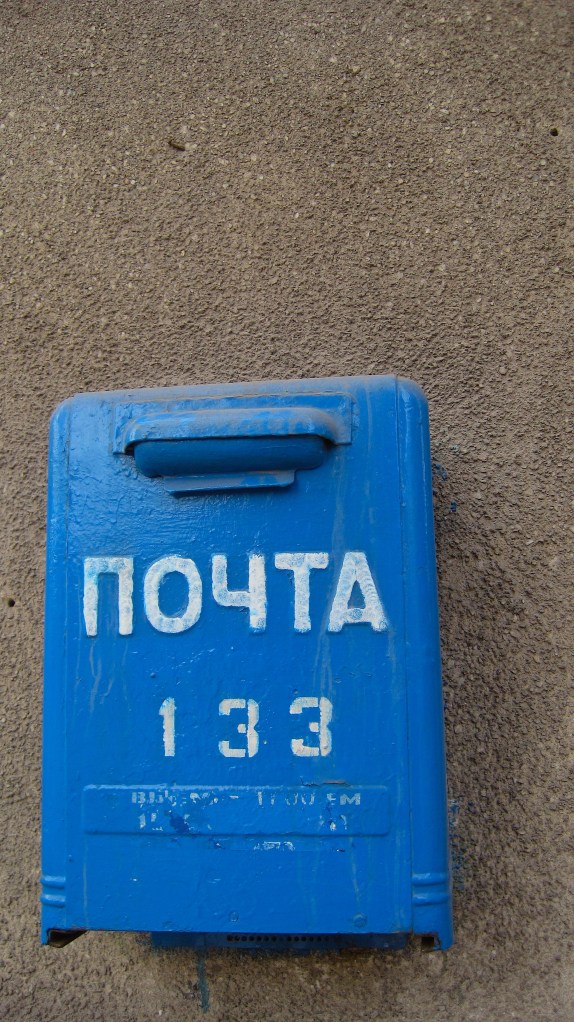
Here in my Bishkek apartment building there is a row of blue postboxes on the ground floor and one with my apartment number painted onto it. But all the little doors to all the boxes are open all the time, and the insides are dusty and empty. The State Department dossier on Kyrgyzstan said it had “a working postal system.” I just don’t get the sense it will be working for me.
To Boldly Go
From my friend Michael in a Facebook message} How’s the new post, Elkie? How’s your corner of the world?
Me} I have this idea. Or maybe it was a dream? I am in a mashup of Star Trek and Bishkek and it is called Star Kek. I am here with Captain Kirk (okay, it is a dream) and together we speak Russian and wear Star Trek uniforms and swashbuckle our way around Central Asia. Out in the countryside there is bride kidnapping, fermented horse milk as the local hooch and a game played on horseback with a headless goat carcass. There are mountains that stupefy with their beauty, one of the largest alpine lakes in the world and the Kyrgyz—poets and storytellers. It’s Warp Factor 10.

All I knew about the Soviet Union when I was a child: Grainy black and white TV news pictures showed Nikita Krushchev deplaning onto a tarmac somewhere with his boxy overcoat buttoned across girth as wide as a refrigerator. He looked kind of grumpy. At my school, St. Francis of Assisi, we had bomb drills because the Communists might press a button and a bomb would blow up. Mrs. McGibney told us that; she was my first grade teacher. To stop the bomb from getting us, we clutched our holy cards, crouched beneath our desks and said a lot of Hail Marys. In history class we learned about the Iron Curtain, but I never really did figure out how did it work? Who made it? How did they get it to hang there? I thought it was a giant shower curtain hanging on a giant curtain rod. Some people were on one side of the curtain and couldn’t go to the other side. Those people ate potatoes and wore grey clothes.
In Other News
Kyrgyzstan has joined the list of “enemies of Valentine’s Day” this year. Tursunbai Bakir Uulu, a member of Kyrgyz parliament (who has been calling for a ban on Valentine’s Day for several years now), recently called February 14 a “holiday from the devil.” The authorities in the southern city of Osh have banned the observance of Valentine’s Day in schools, arguing that the “holiday of love is a bad influence on children’s morality.” Education officials have suggested that schoolchildren should instead observe the Family Day on February 15.
~ from globalvoicesonline.org

The view from my kitchen window of the Tian Shan on the edge of Bishkek before city haze obscures the peaks.